Introduction
The demand for lithium-ion batteries is growing rapidly in India due to the expansion of electric vehicles (EVs), solar energy storage systems, renewable energy projects, and portable electronic devices. Lithium-ion battery technology plays an important role in India's transition towards clean energy and sustainable transportation.
The Institute of Solar Technology (IST) offers industry-oriented training in lithium-ion battery manufacturing, providing students, engineers, technicians, entrepreneurs, and renewable energy professionals with essential technical and practical knowledge of battery technology and manufacturing processes.
Lithium-ion Battery Pack Design course for Engineer & manufacturing team members
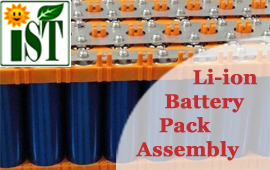 Design battery for Battery Electric Vehicle (BEV), Hybrid / Plug-in Hybrid (HEV/PHEV), 2-Wheeler EV, 3-Wheeler EV, Rooftop Solar Energy Storage (ESS),
Marine, Aerospace and many more application. In India, a pack must pass AIS-156 and BIS tests before it can go on the road.
Who it is for:
- Electrical, mechanical, automotive and energy engineers
- Final-year B.E./B.Tech and M.Tech students
- EV start-up and pack-manufacturing teams
- 2W 3W 4W Battery Pack Design
- Solar ESS Battery Pack Design
- Research output. Figures and tables export ready for papers, theses and conference posters, and a data flowchart shows how each result was produced.
Admission going on Dec - 2026
Lithium-Ion Battery Manufacturing Training Course
This training program is designed to develop technical skills and understanding of lithium-ion battery manufacturing, battery pack assembly, testing, safety, and quality control.
Course Modules
1. Introduction to Lithium-Ion Battery Technology
Fundamentals of lithium-ion batteries.
Types of lithium-ion battery chemistry.
LFP, NMC, NCA and other battery technologies.
Battery applications in solar energy and electric vehicles.
Battery specifications and performance parameters.
2. Lithium-Ion Battery Components
Cathode materials.
Anode materials.
Electrolyte.
Separator.
Current collectors.
Battery casing and terminals.
3. Lithium-Ion Battery Manufacturing Process
Raw material preparation.
Electrode slurry mixing.
Electrode coating.
Electrode drying.
Calendering process.
Electrode slitting and cutting.
Cell assembly.
Electrolyte filling.
Formation and ageing.
Final cell inspection and grading.
4. Battery Cell Manufacturing Technologies
Cylindrical battery cells.
Prismatic battery cells.
Pouch battery cells.
Cell assembly technologies.
Manufacturing equipment and machinery.
5. Battery Pack Assembly Training
Battery cell selection and matching.
Series and parallel cell connections.
Busbar welding and connections.
Battery enclosure design.
Battery pack assembly.
Insulation and thermal management.
6. Battery Management System (BMS)
Introduction to BMS.
Cell voltage monitoring.
Temperature monitoring.
Overcharge and over-discharge protection.
Overcurrent and short-circuit protection.
Cell balancing.
BMS selection and configuration.
7. Battery Testing and Quality Control
Battery capacity testing.
Internal resistance testing.
Charge and discharge testing.
Voltage and temperature testing.
Battery performance evaluation.
Quality inspection and documentation.
8. Battery Safety and Thermal Management
Lithium-ion battery safety.
Thermal runaway prevention.
Fire prevention and emergency response.
Battery protection systems.
Safe storage and transportation.
Recycling and disposal fundamentals.
9. Solar Energy Storage Applications
Lithium-ion batteries for solar systems.
Residential solar battery storage.
Commercial and industrial energy storage.
Off-grid solar battery systems.
Hybrid solar energy storage systems.
Battery capacity and backup-time calculations.
Practical Training and Industrial Skills
The course focuses on developing practical knowledge of battery pack assembly, electrical connections, BMS integration, battery testing, troubleshooting, and quality control.
Participants gain an understanding of the complete manufacturing workflow, from raw materials and cell production to finished battery packs and energy storage applications.
Note: Actual cell-manufacturing operations require specialized industrial equipment, controlled environments, and appropriate safety facilities. Practical activities should be conducted under qualified supervision.
Career Opportunities After Training
After completing lithium-ion battery manufacturing training, participants can explore career opportunities in:
Lithium-ion battery manufacturing industries.
Battery pack assembly companies.
Electric vehicle industries.
Solar battery storage companies.
Battery testing and quality control.
Battery maintenance and servicing.
Renewable energy companies.
Battery research and development.
Battery recycling industries.
Battery manufacturing entrepreneurship.
Who Can Join This Course?
This training program is suitable for:
Engineering students and graduates.
Electrical and electronics technicians.
Diploma holders.
Solar energy professionals.
Electric vehicle technicians.
Entrepreneurs and business owners.
Industrial professionals.
Individuals interested in battery manufacturing.
Why Choose Institute of Solar Technology (IST)?
The Institute of Solar Technology focuses on practical, industry-oriented technical education in renewable energy and related technologies.
Our objective is to develop skilled professionals who understand modern battery technologies, manufacturing processes, battery pack design, testing procedures, and solar energy storage applications.
Enrol for Lithium-Ion Battery Manufacturing Training
Build your technical knowledge and explore opportunities in India's growing lithium-ion battery and energy storage industry.
Join the Institute of Solar Technology (IST) and develop the skills required for the future of battery manufacturing and renewable energy.
Institute of Solar Technology (IST) – Building Skills for a Sustainable Energy Future.