Learn Lithium-Ion Battery Technology Online at Your Own Pace
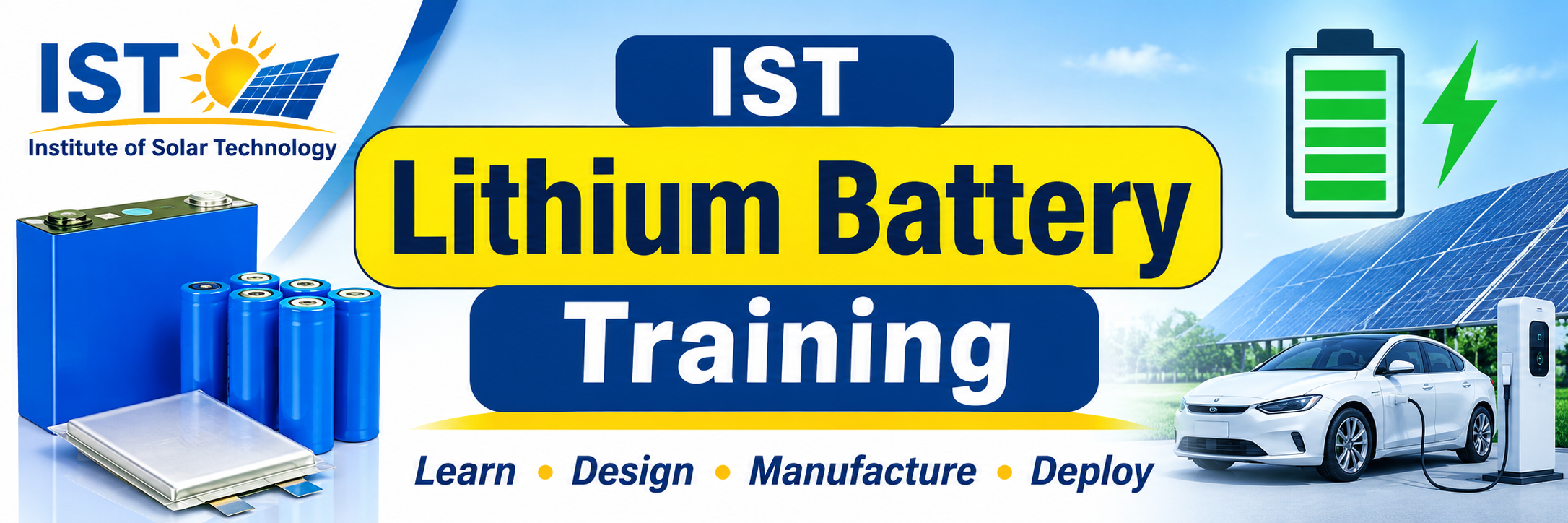
The Institute of Solar Technology (IST) offers a comprehensive Self-Paced E-Learning Lithium-Ion Battery Course designed for students, engineers, technicians, entrepreneurs, solar professionals, and individuals interested in developing skills in lithium-ion battery technology.
This online course provides flexible learning opportunities, allowing participants to study anytime and from anywhere. Learners can understand lithium-ion battery fundamentals, battery components, cell chemistry, battery pack design, Battery Management Systems (BMS), manufacturing processes, testing procedures, safety standards, and practical applications.
Solar Power EV Charging Station Design Course
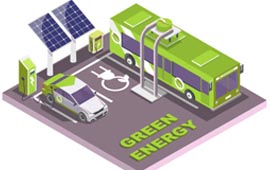 Combo course including Solar PV Technology, Lithium-ion Battery Technology and EV Charging Station Technology
For working professionals, early morning or night class slot available
Solar charging stations for electric vehicles have emerged as one of the best ways to reduce India’s dependence on fossil fuels. Nearly everyone who owns an Electric vehicle will install a solar charging station in their home. Certificate in Solar Power EV Charging Station (Design and Development) Training Program is a master courses that takes an Engineer, designe engineer, installer from site assessment, all the way through power-up and pinpointing.
Admission going on for Dec - 2026
Why Choose a Self-Paced Lithium-Ion Battery Course?
Lithium-ion batteries are becoming increasingly important in electric vehicles, solar energy storage systems, industrial applications, and renewable energy projects. Developing technical knowledge of battery technology can create valuable career and business opportunities.
The self-paced learning format allows students to learn according to their schedules without attending regular classroom sessions.
Key Benefits
Learn anytime and from anywhere.
Flexible online learning schedule.
Understand lithium-ion battery technology from basic to advanced levels.
Learn battery cell types and chemistry.
Understand battery pack design and configuration.
Study Battery Management Systems (BMS).
Learn battery manufacturing processes.
Understand battery testing and quality control.
Explore solar energy storage and EV battery applications.
Develop technical knowledge for employment and entrepreneurship.
Lithium-Ion Battery Course Curriculum
Module 1: Introduction to Lithium-Ion Batteries
Introduction to battery technology.
History and development of lithium-ion batteries.
Working principles of lithium-ion batteries.
Advantages and limitations.
Applications in renewable energy and electric vehicles.
Module 2: Lithium-Ion Battery Chemistry
Lithium-ion cell construction.
Cathode and anode materials.
Electrolyte and separator.
LFP, NMC, NCA and other battery chemistries.
Charging and discharging principles.
Module 3: Battery Cell Specifications
Cell voltage and capacity.
Ampere-hour (Ah) and watt-hour (Wh).
Energy density and power density.
C-rate calculation.
Cell datasheet interpretation.
Module 4: Lithium-Ion Battery Pack Design
Series and parallel cell connections.
Battery voltage and capacity calculation.
Battery pack configuration.
Battery sizing and selection.
Practical battery pack design concepts.
Module 5: Battery Management System (BMS)
Introduction to BMS.
BMS functions and operation.
Cell balancing.
Overcharge and over-discharge protection.
Overcurrent and short-circuit protection.
Temperature monitoring.
Module 6: Lithium-Ion Battery Manufacturing
Raw materials and battery components.
Cell manufacturing overview.
Electrode preparation.
Cell assembly processes.
Battery pack assembly.
Quality inspection and production control.
Module 7: Battery Testing and Quality Control
Voltage and capacity testing.
Internal resistance testing.
Charge-discharge testing.
Battery performance evaluation.
Quality control procedures.
Module 8: Battery Safety and Maintenance
Lithium-ion battery safety.
Thermal runaway fundamentals.
Fire prevention and risk management.
Battery storage and handling.
Battery maintenance practices.
Battery recycling and disposal.
Module 9: Applications of Lithium-Ion Batteries
Solar energy storage systems.
Electric vehicles (EV).
Home battery backup systems.
Commercial and industrial energy storage.
Telecom and UPS applications.
Who Can Join This Course?
Engineering students and graduates.
Diploma and ITI students.
Solar energy professionals.
Electrical and electronics technicians.
Entrepreneurs and business owners.
EV and battery industry professionals.
Individuals interested in renewable energy technology.
Career and Business Opportunities
After developing lithium-ion battery technology knowledge, learners can explore opportunities in:
Lithium-ion battery pack assembly.
Battery testing and quality control.
Solar battery energy storage.
Electric vehicle battery systems.
Battery maintenance and servicing.
Battery manufacturing industries.
Renewable energy project development.
Enrol in the Self-Paced Lithium-Ion Battery Course
Build your technical knowledge with the Institute of Solar Technology (IST). Learn lithium-ion battery technology through a flexible self-paced e-learning programme and develop skills relevant to the growing battery and renewable energy industries.
Institute of Solar Technology (IST)
Learn at your own pace. Build your technical skills. Explore opportunities in the lithium-ion battery industry.
Contact IST for course details, enrolment information, fees, and available learning resources.